Uncovering Art History
Uncovering Art History / November 4th: The Discovery of Tutankhamun’s Tomb - “Wonderful Things” in the Valley of the Kings
04 Nov 2025
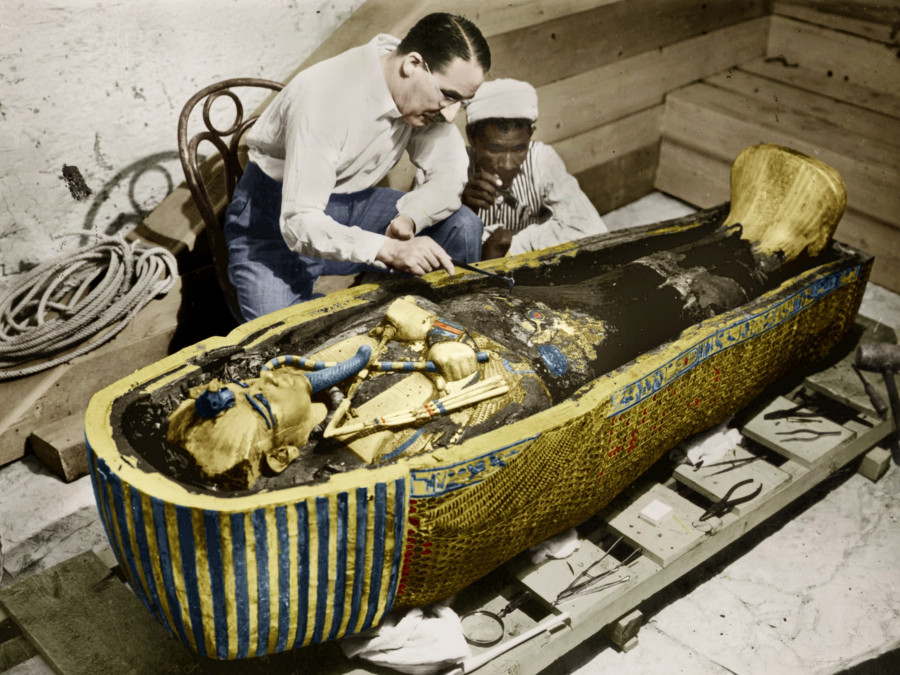
On November 4, 1922, British archaeologist Howard Carter made one of the most significant archaeological discoveries of the 20th century: the tomb of Pharaoh Tutankhamun, hidden deep within Egypt’s Valley of the Kings. This event not only revolutionized the study of ancient Egypt but also captured the imagination of the entire world.
The Long Search for a Lost Pharaoh
For years, Carter had scoured the desert valleys of Thebes, convinced that at least one royal tomb from the 18th Dynasty remained undiscovered. His excavations were financed by Lord Carnarvon, a wealthy English aristocrat and devoted patron of Egyptology.
By 1922, most experts believed the Valley of the Kings had yielded all its secrets. Yet Carter persisted. When a young water boy stumbled upon a stone step while clearing debris from ancient workers’ huts, Carter’s team began uncovering a staircase descending into the bedrock. What they found beneath would soon make history.
The Opening of the Tomb
As Carter dug deeper, he discovered a sealed doorway bearing the necropolis seals. On November 26, 1922, he made a small hole in the plaster, inserted a candle, and peered inside. When Lord Carnarvon asked if he could see anything, Carter replied with words that would echo through history:
“Yes, wonderful things.”
Behind that doorway lay a world untouched for over 3,000 years.
A Tomb Unlike Any Other
The tomb, now known as KV62, was modest in size compared to other royal burials, yet astonishing in its preservation and richness. Unlike most tombs that had been looted in antiquity, Tutankhamun’s remained largely intact, its seals unbroken.
Inside were over 5,000 artifacts: golden statues, jeweled chariots, alabaster vessels, ceremonial beds shaped like divine animals, musical instruments, and fragments of food and wine meant to sustain the young king in the afterlife. The main burial chamber held four gilded shrines nested one inside another, like Russian dolls. At their core lay three anthropoid coffins, the innermost made of solid gold, containing the mummified body of Tutankhamun wearing his now-iconic golden death mask.
Carter described the first glimpse into the antechamber as “the property-room of an opera of a vanished civilisation.”
The Art of Tutankhamun’s Tomb: Splendor in a Sealed World
The discovery of Tutankhamun’s tomb revealed not only royal treasures but also a masterclass in ancient Egyptian artistry. Every object — from the smallest amulet to the massive gilded shrines — was crafted with a level of skill and symbolism that reflected the Egyptian belief in art as a bridge between life and eternity.
The Golden Death Mask: A Portrait of Divinity
Perhaps the most iconic artifact of all time, the gold death mask of Tutankhamun represents the pinnacle of Egyptian goldsmithing.
-
Materials: Crafted from over 10 kilograms of solid gold, inlaid with lapis lazuli, obsidian, turquoise, and colored glass.
-
Symbolism: The mask portrays the youthful king with serene, idealized features, merging human and divine qualities. The striped nemes headdress and false beard link him to Osiris, god of the afterlife.
-
Inscription: On the back, a spell from the Book of the Dead protects the king’s spirit.
Egyptologist Nicholas Reeves has called it “the most perfect union of art and belief ever achieved in ancient Egypt.”
The Nested Coffins: A Golden Trilogy
Inside the gilded shrines stood three anthropoid coffins, each a deeper spiritual layer. The outer and middle coffins were made of gilded wood and inlaid stones; the innermost was solid gold, weighing over 100 kilograms.
The decorative motifs — winged goddesses, hieroglyphic prayers, and protective deities — transformed the coffin into both a work of art and a theological statement of rebirth and protection.
Furniture, Chariots, and Everyday Splendor
Among the tomb’s treasures were furniture, thrones, boxes, and chariots, each combining practicality with sacred beauty.
-
The golden throne depicts Tutankhamun and his queen, Ankhesenamun, in a tender, affectionate pose under the rays of the Aten sun-disc. This intimate scene fuses Amarna-era realism with traditional religious symbolism.
-
Chariots, used both ceremonially and in life, were decorated with hunting and royal imagery in gold leaf, displaying both artistic finesse and engineering ingenuity.
These objects embody how Egyptian art blurred the line between ritual and daily life, ensuring the king’s eternal comfort and majesty.
Sculpture and Guardians
Two life-size black statues of Tutankhamun stood at the threshold of the burial chamber, holding staffs and maces. Their black color symbolized the fertile soil of the Nile and the idea of regeneration. They guarded the tomb as eternal sentinels of the pharaoh’s soul.
Smaller divine figures — of Anubis, Isis, Nephthys, and Ptah — were rendered in gilded wood and faience, maintaining the ideal proportions and poise characteristic of Egyptian sacred art.
Jewelry and Amulets: Beauty as Protection
Tutankhamun’s mummy was adorned with over 140 pieces of jewelry — necklaces, rings, bracelets, and pectorals, each serving a magical purpose.
-
The scarab beetle symbolized rebirth.
-
The ankh represented life.
-
The Eye of Horus offered protection.
Every line, gemstone, and symbol was chosen for both its beauty and its spiritual potency.
An Artistic Legacy Beyond Time
The craftsmanship found in Tutankhamun’s tomb influenced the Art Deco movement of the 1920s, inspiring architecture, jewelry, and design around the world. Yet beyond stylistic impact, these works endure as expressions of a worldview in which art was not decoration, but destiny — a means to ensure life eternal.
The Boy King’s Legacy
Tutankhamun himself ruled for barely a decade and died around age 18 (circa 1323 BCE). Historically a minor figure, he became one of the best-known pharaohs because his tomb offered a nearly complete record of royal life and death. The discovery illuminated Egypt’s religion, craftsmanship, and social structure in ways that no other find ever had.
The “Curse” and the Myth
After the tomb’s opening, rumors spread of a “curse of the pharaohs” said to strike down those who disturbed the royal dead. When Lord Carnarvon died in 1923 from an infected mosquito bite, newspapers sensationalized the story. Yet no such inscription of a curse existed in the tomb, and most of Carter’s team lived long lives. The legend of the curse endures more as a myth of modern media than as an ancient threat.
Years of Work and a Century of Study
It took Carter and his team over ten years to document, photograph, and preserve the tomb’s contents. Their careful methods set new standards for archaeological research and conservation.
Today, most of Tutankhamun’s treasures are housed in the Grand Egyptian Museum in Giza, where modern technology continues to reveal new insights into the boy king’s life, health, and burial.
A Tomb That Changed the World
The discovery of Tutankhamun’s tomb — “the tomb that changed the world” — reignited global fascination with ancient Egypt, reshaped archaeological practice, and inspired generations of artists, historians, and dreamers.
Through Carter’s persistence and the artistry of a vanished civilization, the fragile voice of a young pharaoh — silenced for more than three millennia — speaks again, whispering through gold and silence from the Valley of the Kings.
Story by Cosmina M Oltean
- Photo by National Geographic
Sources:
-
National Geographic – “How Howard Carter Discovered King Tut’s Golden Tomb”
-
Britannica – “Howard Carter” & “Tutankhamun”
-
Smithsonian Magazine – “The Discovery of King Tut’s Tomb”
-
World History Encyclopedia – “Wonderful Things: Howard Carter’s Discovery of Tutankhamun”
-
Euronews – “The Tomb That Changed the World: 100 Years On”
-
Scientific American – “King Tut Mysteries Endure 100 Years After Discovery”
-
The Metropolitan Museum of Art & British Museum archives on Egyptian art
All news